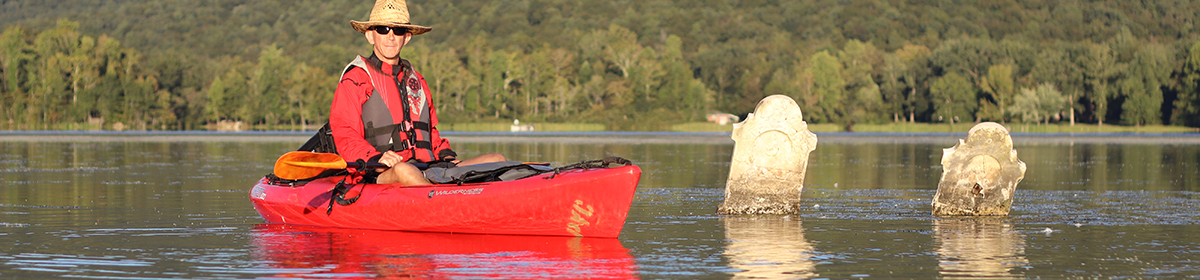
By Keith Harper – The Cemetery Detective
After weeks of slow travel through the Southern lowlands, I arrived at Bonaventure Cemetery by way of the old river road, winding along the fringes of Savannah, Georgia.
My car, a modified 2015 Honda Accord that I have come to call the Hondaminium, carried all my necessary provisions: sleeping platform, boots, books, kayak strapped on top, a notebook of my geological field drawings, and a laptop computer filled with video and photos and GIS Maps from my prior cemeteries. It is a humble vessel, but it has taken me across this continent and into the quiet corners where stone and memory meet.
In no way would I ever compare my wanderings to those of John Muir, but in some ways, he inspires the paths I take. John Muir was a great naturalist and founder of the Sierra Club. He was not just a mountaineer of the western ranges but a wandering philosopher of the American landscape. In 1867, after a factory accident left him temporarily blind, he set off on foot from Indiana to the Gulf of Mexico, seeking healing in the wild. With a handmade plant press and a tattered copy of Paradise Lost, he walked over 1,000 miles alone, penniless, often sleeping beneath trees or in abandoned cabins. His journal from that journey, later published as A Thousand-Mile Walk to the Gulf, is a blend of scientific observation, spiritual reflection, and poetic wonder. One chapter, “Camping Among the Tombs,” describes six nights he spent in Bonaventure Cemetery, then a largely forgotten tract of live oaks and old gravestones on the edge of Savannah. Far from finding it morbid or melancholy, Muir saw in Bonaventure a sublime harmony between life and death, nature and memory. It is this chapter, and that sense of reverent curiosity, that I carried with me on my own visit.
I arrived at Bonaventure Cemetery on a warm, still morning. The air tasted faintly of salt and pine. Great arms of live oak stretched over the road, their limbs clothed in Spanish moss and resurrection ferns. I passed ragged fields, broken fences, and a series of stilt-legged cottages near the water. Just beyond, the forest seemed to open, and I knew I had arrived.
The gates of Bonaventure stood solemn yet inviting. I parked beneath a canopy of green and began my walk.
The ground was soft and littered with pine needles and camellia petals. Oaks, magnolias, and palmettos formed groves around the family plots, their trunks straight and noble as stone columns. Muir once wrote, “One can hardly think of another place where the natural and the supernatural seem so lovingly entwined.” I found it to be just so. Nature was not in conflict with the dead here; it walked hand in hand with them.
I wandered slowly, as I always do in these places, letting my attention fall equally on the botanical and the sepulchral. My interest in graveyards is not born of morbidity, but of inquiry. I am a student of geology by inclination, and of cemeteries by profession. I believe every gravestone tells a dual story; one of the person it memorializes, and another of the earth it was carved from.
Many of the oldest monuments in Bonaventure are made of marble, that metamorphic product of pressure and time, beloved by sculptors for its softness and by mourners for its elegance. But marble is a delicate stone in humid air. Acid rain and salt drift from the river cause it to sugar breaking it down into powdery grains that slough away with the years. As I examined a white marble headstone adorned with an angel now almost faceless, I saw the inscription was worn smooth. Only the outline of the angel’s wing remained to hint at the stonecutter’s intent. A slow and silent erosion, like memory fading.
Farther along I found granite markers, darker and more stoic. Their inscriptions were sharp still with biotite and quartz reflecting the midmorning light. Granite does not sugar, though it may crack. It is igneous, born of ancient heat and cooling deep within the crust. These stones, quarried in Georgia or Vermont or sometimes as far away as India, will likely outlast the names they carry.
Each monument I came upon presented a different combination of material and meaning. A column broken midway to symbolize a life cut short. A weeping willow carved in relief upon slate. A clasped hand, the fingers gently parting. These symbols are not idle ornaments, they are languages I strive to interpret, which still speak for those long gone.
Bonaventure is not a place of fear. It is a place of stillness and story. As Muir observed in his own visit here over 150 years ago, “the few graves are low and in no way interrupt the general flow of the forest floor.” Life persists. Resurrection ferns curl and unfurl on tree limbs. Mockingbirds call from the thickets. The dead rest not beneath but within the rhythm of the landscape.
At one quiet bend in the path, I stopped and stood for a long time, staring into a dense pocket of shrubbery beyond a weathered family plot. The sun filtered in through the moss, and for a moment, the cemetery fell utterly silent. I imagined Muir here, weary from the road, swatting at mosquitoes, settling down amid the roots and stones. He wrote that he chose Bonaventure as a place to sleep because it was safer than the surrounding wilderness, yet awoke to find his head resting on a freshly dug grave. The image clung to me. As I stood among the brush, I could almost see him lying there, curled among the palmettos, journal clutched to his chest.
Later that afternoon, I unstrapped my kayak from the roof of the Hondaminium and carried it down to the nearby water’s edge. I paddled through narrow inlets where cypress knees broke the water’s surface and egrets stalked the reeds. The Wilmington River, wide and flat, moved lazily past the cemetery’s bluff. I drifted beneath the very trees I had stood among that morning, their roots braced in mud, their limbs catching wind and whisper.
It felt right to trace the edge of the graveyard by water. Water, like time, wears down even the hardest stone. And like grief, it cannot be held still.
That night, I returned to my car. I prepared a modest supper from my cooler and reclined the seat to re-read John Muir’s chapter by headlamp. I thought of Muir sleeping among the tombs, wrapped in the scent of earth and fallen leaves. I could not bring myself to unroll my bedroll within the cemetery gates because the times and laws are different now, but I car-camped nearby, safe in my Hondaminium tucked beneath an oak on a tree-lined street. As I unfolded my mattress on my sleeping platform with my head resting cozily on a soft, cool pillow, I thought about Muir resting his head on a freshly dug grave, and in spirit I shared the same peace as John did.
Bonaventure had given me what it had given Muir: a quiet place to study, to wonder, and to reconnect with the simple fact that we, too, will return to the elements from which we came. Stone, soil, water, breath.
In the morning, I walked once more beneath the arching oaks, their limbs still heavy with moss and memory. I took no souvenirs, only notes and a few final photographs, though none could capture what lingered in the air. My footprints, soft upon the pine needles, were soon erased by the breeze. The cemetery remained as I had found it: solemn, sun-dappled, and quietly alive. As I turned back toward the road, I thought of Muir rising from his earthen bed, brushing off the dew, and continuing his thousand-mile walk. I had come by car, not by foot, and stayed just a short while, yet I, too, left changed. In Bonaventure, among the tombs and trees, we had both found something enduring; not death, but the echo of life, layered in stone and soil, whispering still.